National Jewish Health
From paper to spreadsheet to app
Executive assistant to the Chief Nursing Officer; sole builder of the float-pool scheduler
Workbooks in use; app in IT security review The app waits on that review before any operational use.
Before and after
Before
- Staff Gets the schedule via a texted photo , done by hand
- Spreadsheet Anyone with the link can edit , done by hand
- Scheduler Rebuilds the grid by hand , done by hand
- Scheduler Reconciles changes by hand , done by hand
After
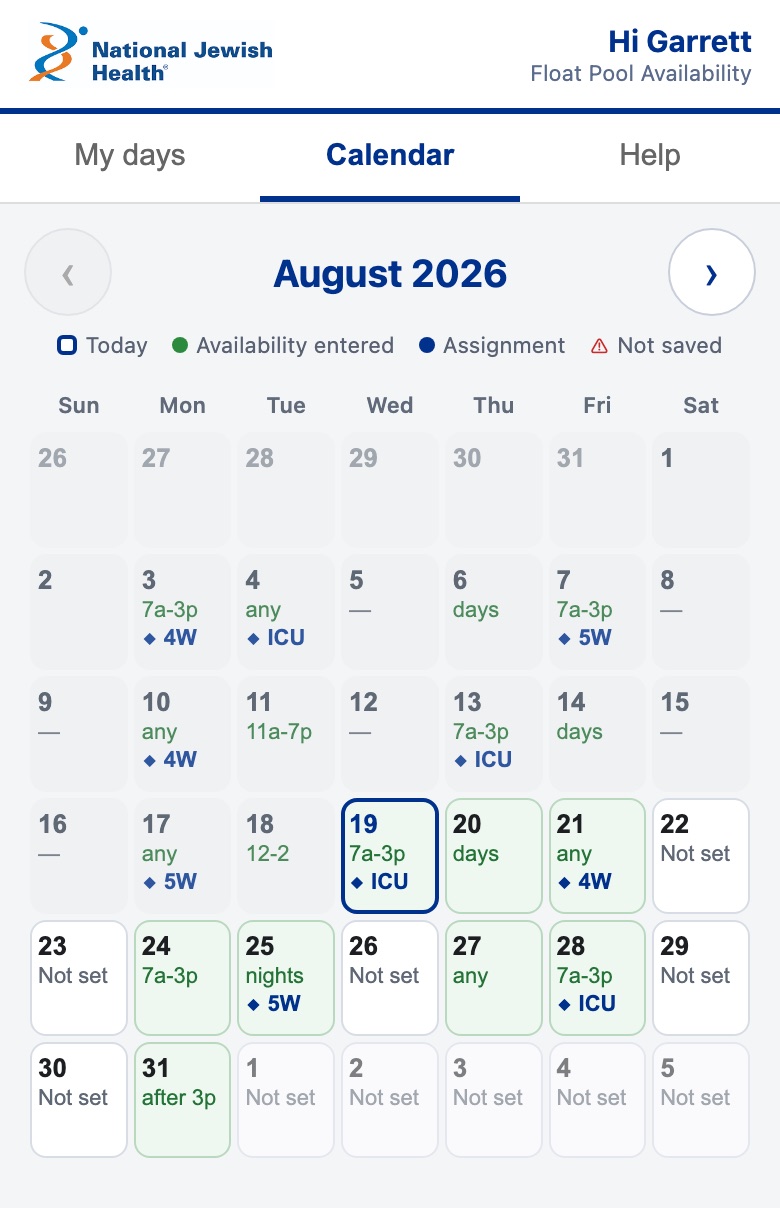
- Staff Opens a personal, no-login link , done by hand
- Staff Types availability, autosaved , done by hand
- System Checks the token on every call , automated
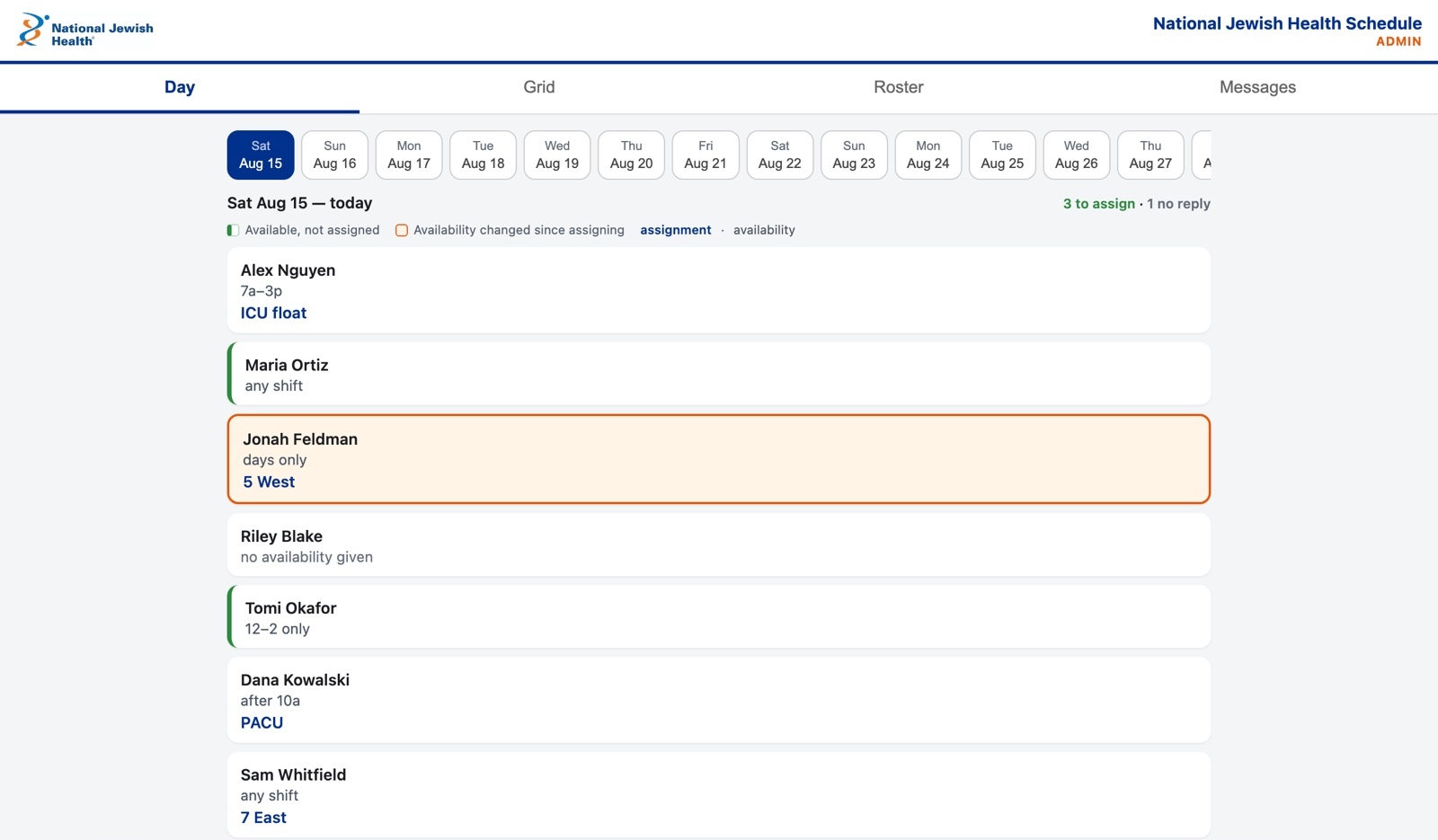
- System Flags a shift if availability changed , automated
- Scheduler Reviews flagged shifts, decides , reviewed by a person
- System Pushes shifts to staff calendars , automated
- Person reviews
- Automated
- By hand
The work before
Seven staffing areas ran their schedules on paper, and building each one by hand cost every manager hours a week.
The float pool's schedule lived on one physical sheet of paper, then on one shared spreadsheet anyone with the link could edit, including rows already final. There was no reliable record of who changed what: version history names a Google account, not a person. A desktop grid, read on a phone, took hours to build and more hours to reconcile.
The call
The seven-area rollout automated the arithmetic and the layout: formulas that build the grid, not the judgment of who works which shift. That call stayed with each manager.
The float pool went further because its availability can change after a shift is already booked against it. The system flags that case for a person to look at again; it does not resolve it. There is no model in this product. Whether a flagged shift gets reassigned is still a scheduler's call, made by reading the flag.
Automated
- Building the weekly grid from formulas, not by hand
- Checking a personal link's token on every request
- Flagging an assignment when the person's availability changed since it was booked
- Pushing shifts into calendar apps people already use
- Refreshing an hourly emergency workbook as a standby
Kept with a person
- Who works which shift, always a scheduler's decision
- Whether a flagged, already-booked shift gets reassigned
- Granting admin access, done only by the operator, never by request
Guardrails and evals
Staff hold a personal link with a private token checked on every call, so a person can only ever see and edit their own row; an admin can rotate a leaked link in one tap. Every write is timestamped and logged to an append-only audit trail.
The Google Sheet stays the database and the fallback: readable, printable, and editable without the app, with a private emergency workbook refreshed every hour if the app itself is down. A tested three-way merge tool exists to fold emergency edits back in, and is deliberately held back until it is actually needed.
Rules
- Every server function re-checks the caller's token; there are no passwords or accounts
- Maintenance functions (backup, migration, link listing) require a signed-in operator identity, not just a valid staff link
- The scheduler stores a display name and free-text availability only: no patient data, no clinical information, no staff contact details
Evals
- 236 tests, 13 files, run on every push: API contract, authorization rules, a static-markup scan
Rollout and adoption
The seven-area workbook rollout is in use: cloud, formula-driven sheets replaced paper across all seven areas, each manager got several hours of administrative work back a week, and staff got real flexibility in how shifts get filled.
The float-pool scheduler is built, deployed, and live at njfloatpool.org, and is currently in the hospital's IT security review before use with hospital data. Separately, I have trained colleagues at NJH on using AI tools, and I mainly use AI to improve my own workflows, on non-patient work only; no patient data goes into any AI tool.
How it was built
I wrote the spec and reviewed every change; an AI coding agent wrote most of the code: 56 of the repository's 70 commits carry an AI co-author. Since July 31, 2026, every push to main has run the test suite (236 tests today) in CI. Deployment is a deliberate, human-run two-step: push the code, then cut a new version on the existing stable deployment so no staff link changes.
Tools: Google Apps Script, Google Sheets, Cloudflare Pages, Node test runner
Questions about this one: email me.